
E-NOSES
Court of Appeal imposes heavy penalties for illegal sailing degassing
The Court of Appeal in Amsterdam has sentenced a tanker ship captain to a fine of 20,000 euros for illegal sailing degassing in April 2022. The shipping company must pay 100,000 euros. Half of the fines are conditional. The judges ruled that measurements from e-noses are admissible evidence.
René Quist Amsterdam, April 24, 2026, 1:35 PM
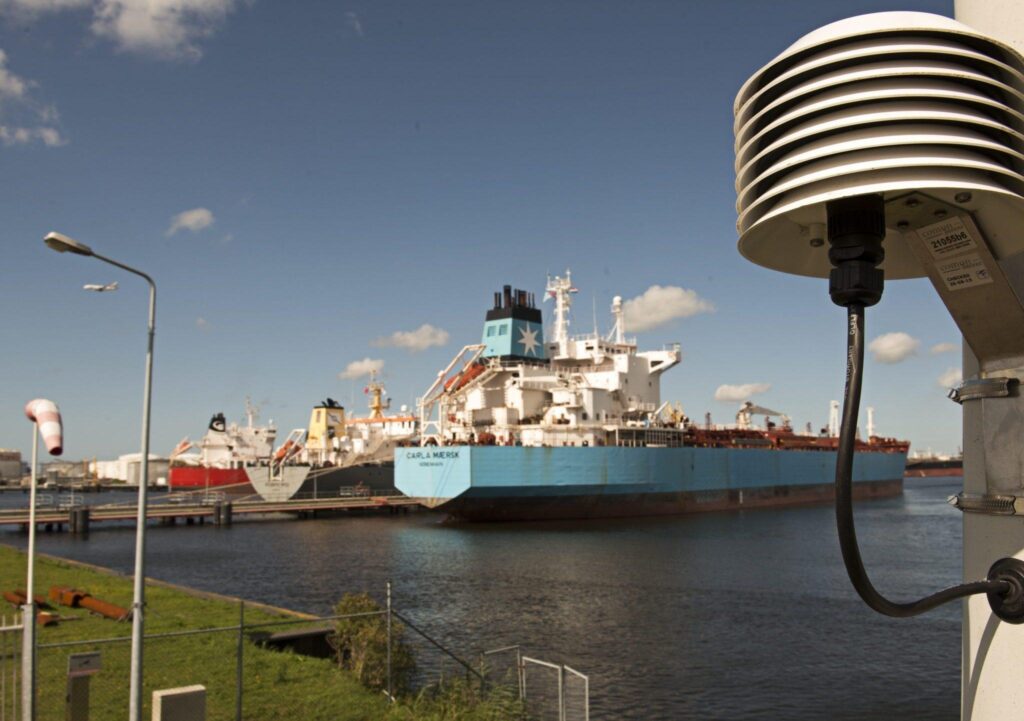
The Court of Appeal in Amsterdam has ruled that data from e-noses may be used by the ILT to track ships that are degassing while sailing. Photo Port of Amsterdam
The Court of Appeal ruled in early April 2026 in three similar cases. In the second case, the court imposed a fine of 15,000 euros on the captain and 75,000 euros on the company, both partially conditional. In the third case, the amounts are lower, with 10,000 for the captain and 50,000 for the company, also partially conditional.
The tanker ships were illegally degassing in the vicinity of densely populated areas and under bridges. In one case, gasoline was also degassed, which is prohibited in all cases.
Earlier, those involved were acquitted, after which the Public Prosecutor’s Office appealed. The three rulings clearly show that e-noses, electronic sensors that detect changes in air quality, are permitted as evidence. A lower court had previously ruled that e-noses may only be used as evidence to a limited extent.
ILT
In a statement, the ILT responds to the rulings. ‘Together with police and Rijkswaterstaat, among others, the ILT uses technical tools for supervision of sailing degassing. Such as e-noses (the so-called sniffer poles), drones and AIS signals (Automatic Identification System) to automatically signal, identify and track ships. With these convictions, the court of appeal rules that the ILT may lawfully use these technical tools.
Sailing degassing is permitted in certain parts of the Netherlands. Captains can use a special map from the Human Environment and Transport Inspectorate (ILT) to see where sailing degassing is still allowed.
How do e-noses work?
The e-noses are owned by the company Comon Invent, which uses the ‘Degassing Vessel Detective tool’ connected to this network to link the measurements with AIS data to the ship that was passing by at that time. Comon Invent then assigns this ship a pseudonymized CIID number and passes this information to the Environmental Service North Sea Canal Area, which forwards the reports to the ILT.
AIS data was also used in the three cases. AIS data from inland vessels may be used as an investigation tool. Only when it comes to private ships does the captain’s privacy take precedence over the investigation interest. This was previously determined by the Amsterdam court in a thematic session on sailing degassing.
The third phase of the ban on sailing degassing in inland tank shipping will take effect on October 1, 2027.
The first phase of the ban on sailing degassing took effect on July 1, 2024. Phase 2 followed on October 1 of the same year. Phase 3 would take effect three or four years later, which now appears to be October 1, 2027. Phase 3 concerns the cargo types acetone, ethanol and methanol.
With the start of the third phase, demand for degassing capacity will likely increase. That demand is still virtually absent, as emerged from a survey by this newspaper. Shippers, who are responsible for any degassing costs, have enough options to prevent degassing or to avoid payment in freight negotiations.
Dedicated transport
Within the CDNI agreement, it has been agreed that the shipper is responsible for cargo residues/gases and their removal. But in practice, there are many possibilities to avoid that responsibility. There is plenty of ship capacity available, so the shipper can usually choose an option without having to degas.
Such as a ship that sails dedicated or compatible (with the same product or products that can be loaded on top of each other) and therefore requires no degassing. The result is that ships that do want to go to a degassing facility don’t get the voyage. The ship owner has the choice: wait for suitable cargo or pay for degassing themselves.